


Tel
+86-13153158953

Email
sales@sequoyatec.com
Laser cleaning has become an increasingly popular solution for removing rust, paint, oil, oxide layers, and other surface contaminants from industrial components. Compared with traditional cleaning methods such as sandblasting and chemical cleaning, laser cleaning offers a contact-free process without the need for chemical solvents or abrasive materials.
However, when choosing a laser cleaning machine, buyers often face one important question: Should you choose a continuous wave (CW) laser cleaning machine or a pulsed laser cleaning machine?
Although both technologies are designed for surface cleaning, they work differently and are suitable for different applications.
A continuous wave laser cleaning machine delivers laser energy continuously onto the surface of a workpiece. The absorbed energy heats the unwanted coating or contamination, causing it to decompose, vaporize, or separate from the base material.
CW laser cleaning machines are commonly used for industrial applications that require relatively high cleaning efficiency and large-area coverage.
Typical applications include:
l Rust removal from carbon steel plates and metal structures
l Paint removal from steel surfaces
l Cleaning heavy industrial equipment
l Surface preparation before welding or coating
l Removing stubborn surface contaminants from metal components
With suitable laser power and process parameters, continuous laser cleaning can provide an efficient solution for large-scale industrial cleaning.
A pulsed laser cleaning machine releases laser energy in short pulses rather than continuously. Each pulse delivers energy to the surface within a very short period, helping remove unwanted materials through rapid heating, thermal stress, and material ablation.
Because the energy is delivered in controlled pulses, the heat input to the base material can generally be reduced.
Pulsed laser cleaning is particularly suitable for applications where surface quality and material protection are important.
Common applications include:
l Removing oxidation and discoloration from stainless steel welds
l Cleaning aluminum alloy components
l Removing rust from precision metal parts
l Cleaning molds and industrial tools
l Removing oil, paint, and surface coatings from selected components
l Cleaning metal parts that require minimal thermal impact
For delicate components and applications requiring better control over the cleaning process, pulsed laser cleaning is often a preferred option.
The main difference between these two technologies is how laser energy is delivered to the workpiece.
Continuous Laser Cleaning Machine (CW)
l Continuous laser output
l Suitable for large-area cleaning
l Often offers higher cleaning efficiency for heavy rust and paint removal
l Commonly used for steel structures and industrial metal surfaces
l Requires proper heat management to prevent excessive thermal effects
Pulsed Laser Cleaning Machine
l Laser energy delivered in short pulses
l Lower overall heat input can be achieved with appropriate parameters
l Suitable for precision cleaning applications
l Commonly used for molds, aluminum alloy parts, stainless steel, and precision components
l Offers better control when protecting the original surface is important
It is worth noting that cleaning performance depends not only on laser type but also on average power, pulse energy, pulse duration, scanning speed, focal position, and the properties of the material being cleaned.
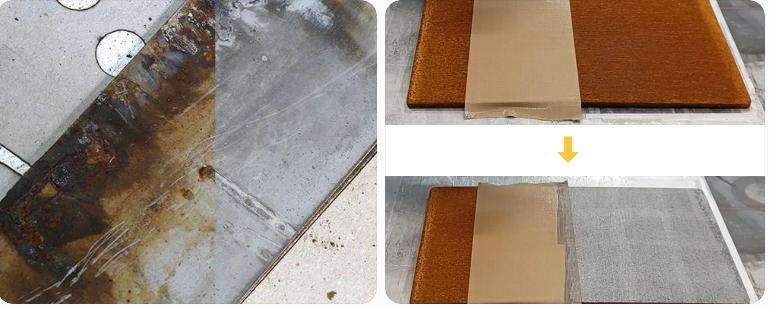
Both continuous and pulsed laser cleaning machines can process various metal surfaces, but the appropriate choice depends on the material and the contamination.
Carbon Steel and Iron
Both technologies can remove rust, paint, and surface contaminants. Continuous laser cleaning is often suitable for large steel structures and heavy rust removal, while pulsed laser cleaning is useful for more controlled surface treatment.
Stainless Steel
Both types can remove surface oxidation and contaminants. Pulsed laser cleaning is often selected for weld discoloration and precision surface cleaning where excessive heat or color changes should be avoided.
Aluminum Alloy
Pulsed laser cleaning is generally preferred for many aluminum alloy applications because excessive heat can affect thin or delicate components.
Copper and Brass
These materials require careful process adjustment because of their optical reflectivity and thermal properties. Pulsed laser cleaning may be suitable for selected applications, but sample testing is recommended.
Molds and Precision Components
Pulsed laser cleaning is commonly considered for removing mold residues, oil, oxidation, and selected coatings while maintaining better control over the base material.
Before purchasing a laser cleaning machine, it is important to understand the actual cleaning requirements.
Consider the following questions:
1. What material needs to be cleaned?
2. What needs to be removed: rust, paint, oil, oxidation, or another coating?
3. How thick is the contamination layer?
4. What is the size of the workpiece?
5. Is high cleaning speed more important, or is surface protection the priority?
For large steel structures, thick rust, and high-volume industrial cleaning, a continuous laser cleaning machine may be a suitable solution.
For precision components, molds, aluminum alloy parts, and applications requiring controlled heat input, a pulsed laser cleaning machine is often worth considering.
The best way to select a machine is to test it with the actual workpiece and evaluate cleaning speed, surface quality, and material condition after cleaning.
At Shandong Jinan Sequoyatec Co., Ltd., we focus on industrial laser equipment and related manufacturing solutions. We understand that different customers have different cleaning requirements, materials, and production conditions.
Whether you are looking for a continuous laser cleaning machine for industrial rust removal or a pulsed laser cleaning machine for precision surface cleaning, choosing the right configuration is essential.
Contact our team to discuss your application and machine requirements. We can help you evaluate suitable laser cleaning solutions for your business.
 Tel : +86-0531-88618510
 Whatsapp : +8613153158953
 Email : sales@sequoyatec.com
Email : info@sequoyatec.com
 Dirección de la oficina: sala 925, provincia de Ron G, bloque C, nº 9 B EI source street, l I distrito Cheng, Jinan, S Han Dong, China


